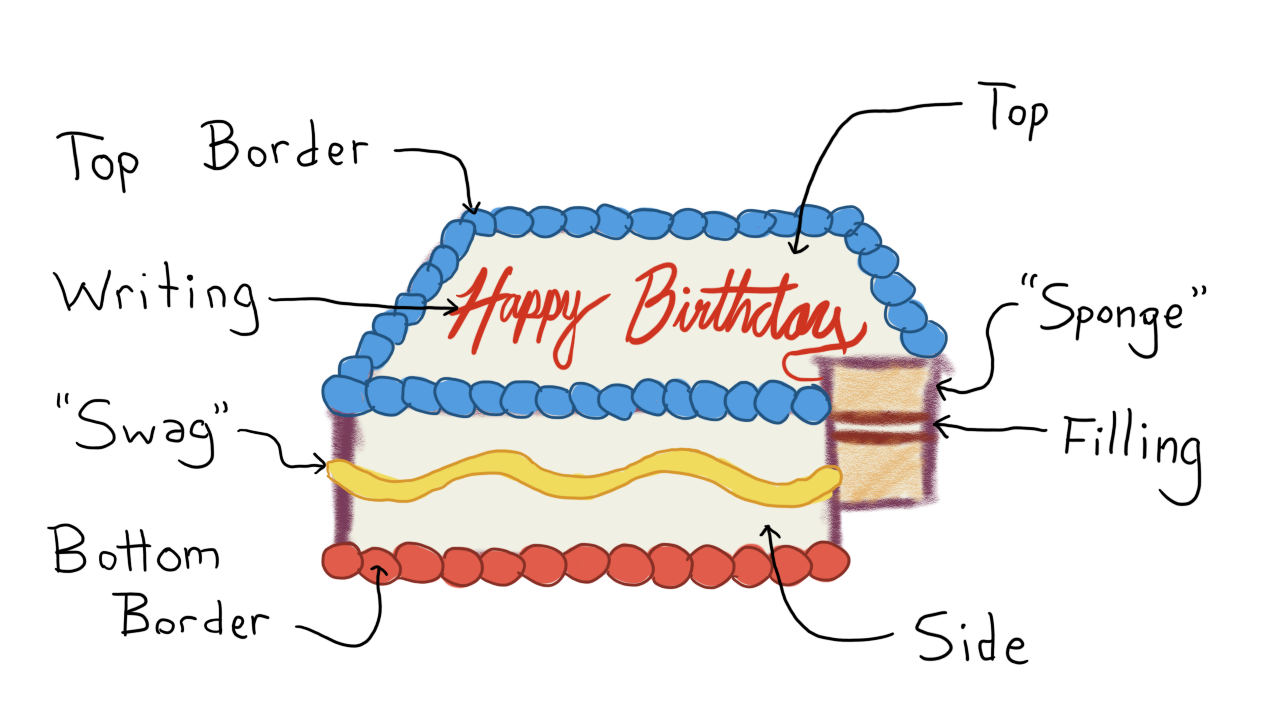
1. Sponge
This is the cake itself; the part of a cake that is actually cake. This should comprise a majority of the volume of the final product, but should be completely covered in frosting during the decorating process. The frosting coat will keep the sponge fresh and moist.

2. Filling
This is what goes between the layers of sponge. There can be more than two layers of sponge and more than one layer of filling. Filling is not at all further covered in this guide whatsoever; it is completely unneccesary in most contexts, and can very easily be a layer of frosting; the only purpose it serves is flavor. The shop I worked at did not use filling in any way beyond enough icing to stick the sponge layers together, and this is fairly common for "cheap" supermarket cakes.
3. Base Icing (Not Labelled)
The base layer of frosting over the whole cake; pictured here to cover the Top and Sides of the cake.
4. Top Border
The band of colorful frosting on the edge between the Top and Side of the cake. Most often it is mostly on top, because gravity exists, but hangs over the side enough to cover any frosting errors. Most, but not all, cakes have a top border; it is more minimalist to leave it off.
5. Bottom Border
The band of frosting on the very bottom of the side of the cake, usually resting on the cake board. Every single cake should have a bottom border; it it what ensures the cake does not slide around on the presentation board, and hides any handling marks. Even the most minimalist of designs should have a simple ribbon-strip bottom border of the same color as the base icing.
6. "Swag"
Not sure why it is called this; this is the decorative edging on the side of the cake. It helps to make a cake look taller, and add a pop of color. Most cakes have some form of swag.
7. Writing
This is the message on the cake! The most often-used by far is "Happy Birthday", but just about anything can go here under the right circumstances. In most commercial settings, "Happy Birthday" should be included as a default message on about 40% of ready-to-buy products in the normal display; with space underneath to add an individual name if wished. Specific holidays can also have their particular saying included in that particular display, such as "Happy Father's Day" for father's day, and "Congratulations" for graduation season. Make sure you spell all writing correctly for both ready-to-buy displays and individually ordered products, including triple-checking the spelling of any names.